

I’m an introvert, and I used to think that was a disadvantage.
In a world that often rewards the loudest voice in the room, it’s easy to feel like you need to shout to be heard or become someone else to succeed. I started looking through history for leaders who led with quiet strength instead of loud voices. I wanted to find those who ruled with reflection, presence, and restraint.
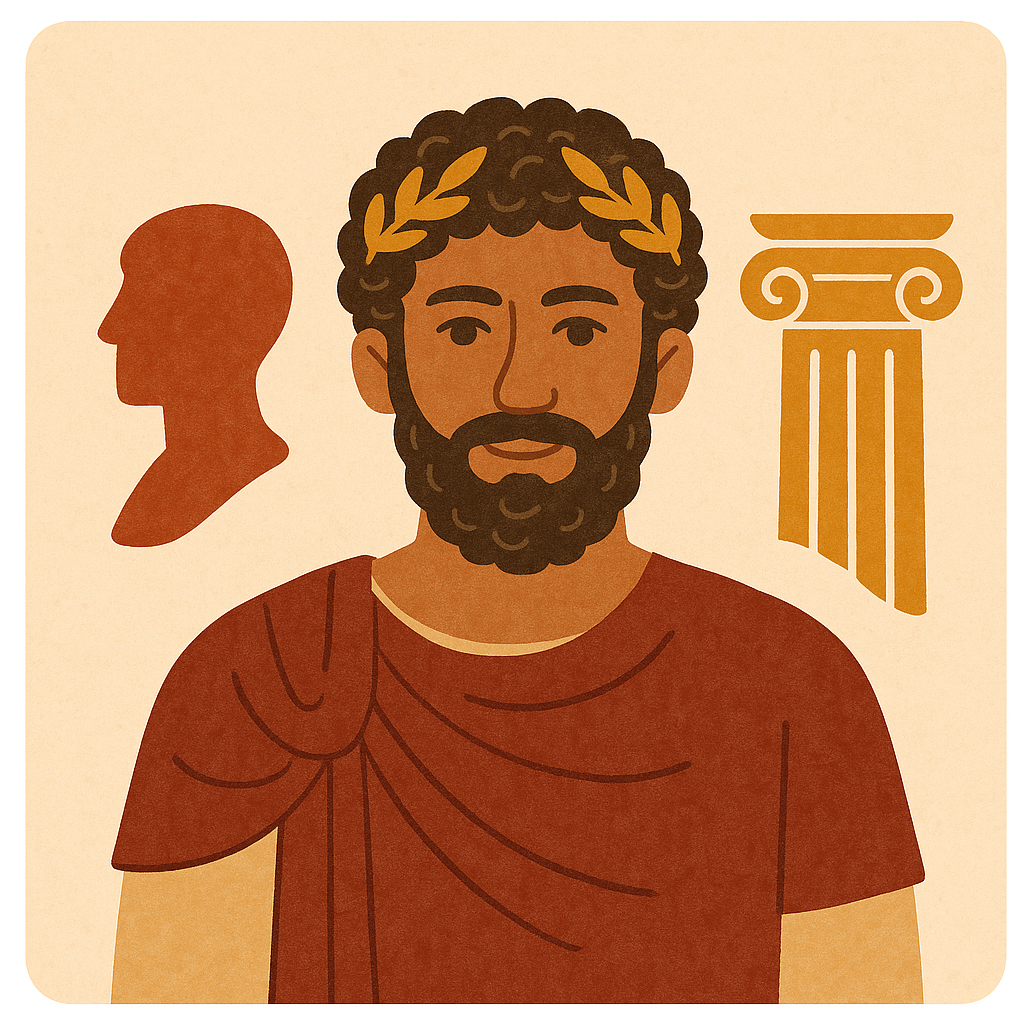
That’s when I discovered Marcus Aurelius in a completely new light.
He’d always hovered at the edge of my awareness. I knew him vaguely as a Stoic philosopher, the guy who wrote Meditations, and wore togas in marble busts. But I had never felt him—not until I started reading his personal writings with the eyes of an introvert looking for ways to lead quietly. That’s when something clicked.
Here was someone who didn’t just survive as an introvert—he led the entire Roman Empire, fought wars, withstood plagues, betrayal, and loss, and still took the time to remind himself that nowhere you can go is more peaceful than your own soul.
The Emperor’s Private Struggle
Marcus didn’t write Meditations for us. It was a journal—just a man trying to coach himself through the crushing weight of duty, grief, ego, and temptation. And it’s drenched in the contemplative, solitary inner world that introverts truly understand.
Picture the most powerful man in the world, commanding 65 million people across three continents. Every decision affects millions of lives. Wars rage on distant frontiers while plagues devastate cities. Generals, senators, and dignitaries demand constant attention.
And every morning, he has to give himself a pep talk just to face the people he’ll meet that day.
Reading his Meditations with fresh eyes, I realized I was looking at the private thoughts of someone who understood exactly what I was going through. Here was proof that the highest levels of achievement were possible without sacrificing what made you essentially you.
The Evidence: Why Marcus Was Definitely an Introvert
The evidence becomes overwhelming once you know what to look for. Marcus spent considerable mental energy preparing for social interactions:
“When you wake up in the morning, tell yourself: Today I will meet people who are meddling, ungrateful, arrogant, dishonest, jealous, and surly. They are like this because they cannot tell good from evil. But I have seen the beauty of good, and the ugliness of evil, and have recognized that the wrongdoer has a nature related to my own—not of the same blood or birth, but the same mind, and possessing a share of the divine. And so none of them can hurt me.”
Book 2.1
This isn’t pessimism—it’s an introvert’s survival strategy. Any introvert recognizes this pattern: mentally preparing for social drain, setting expectations to preserve energy. He had to psych himself up for human interaction the same way we do before networking events or difficult meetings.
He constantly reminded himself about finding refuge in solitude:
“People seek retreats for themselves in the countryside, by the seashore, at the mountains—and you too have made it your habit to long for such things. But this is altogether the mark of a most common person, for it is always possible for you to retire into yourself. For nowhere either with more quiet or more freedom from trouble does a man retire than into his own soul, particularly when he has within him such thoughts that by looking into them he is immediately in perfect tranquility.” (Book 4.3)
This is classic introvert wisdom: your power comes from within, not from external energy or validation. While other emperors reveled in spectacle, Marcus found his strength in solitude and reflection.
He was constantly managing his energy and protecting his attention:
“If you seek tranquillity, do less. Or more accurately, do what’s essential—what the logos of a social being requires, and in the requisite way. Which brings a double satisfaction: to do less, better. Because most of what we say and do is not essential. If you can eliminate it, you’ll have more time, and more tranquillity. Ask yourself at every moment, ‘Is this necessary?’” (Book 4.24)
This sounds like someone drowning in obligations, desperately trying to protect limited social and emotional resources for what truly mattered. The emperor of Rome was practicing what we now call introvert energy management.
The Introvert’s Secret Weapon: Internal Transformation
Marcus had mastered something that introverts are uniquely positioned to understand—the power of internal transformation. While extroverts gain energy from external stimulation, we introverts spend most of our time in our internal world. Marcus figured out how to turn this apparent limitation into his greatest strength.
He understood that thoughts literally shape reality:
“The things you think about determine the quality of your mind. Your soul takes on the color of your thoughts.”
Book 5.16
This isn’t just philosophy—it’s an introvert’s instruction manual. Because we naturally spend so much time with our thoughts, we have more opportunity to curate and shape them. Marcus was essentially describing what we now might call manifestation: deliberately choosing thoughts that transform you from the inside out.
More radically, he knew that:
“The universe is change; our life is what our thoughts make it.” (Book 4.3)
Most people think thoughts reflect reality. Marcus discovered what many introverts intuitively sense: thoughts actually create reality.
This is why introversion can be such an advantage. While others are constantly reacting to external stimuli, we have this rich internal laboratory where we can process experiences, test different mental frameworks, and refine our thinking. Marcus spent hours each evening in this internal space—not just journaling, but systematically preparing his mind for the challenges ahead.
The emperor he became in his private thoughts each night was the emperor the world experienced the next day.
How Marcus Weaponized His Introversion
What makes Marcus extraordinary isn’t that he overcame his introversion—it’s that he weaponized it. He turned every supposed weakness into a competitive advantage.
His emotional sensitivity became unshakeable calm. While others were reactive and volatile, Marcus learned to process internally and respond thoughtfully:
“You have power over your mind – not outside events. Realize this, and you will find strength.”
Book 2.11
He had learned to use his internal world as an anchor, creating calm from within that others experienced as leadership presence.
His empathy became exceptional judgment:
“Whenever you are about to find fault with someone, ask yourself the following question: What fault of mine most nearly resembles the one I am about to criticize?” (Book 6.34)
This combination of emotional intelligence and pattern recognition gave him insights that more externally focused leaders missed entirely.
His natural tendency toward reflection became emotional regulation mastery:
“You always own the option of having no opinion. There is never any need to get worked up or to trouble your soul about things you can’t control. These things are not asking to be judged by you. Leave them alone.” (Book 6.52)
Most importantly, his introversion forced him to think systematically:
“What is not good for the swarm is not good for the bee. If the whole suffers, so will the part. Your individual success is tied to the health of the group.”
Book 6.54
This wasn’t just altruism; it was enlightened self-interest born from deep thinking about how systems actually work.
What Marcus Taught Me About Leading Quietly
Reading Marcus’s private struggles fundamentally changed how I approached my own challenges. I realized I’d been trying to succeed despite my introversion when I should have been succeeding through it.
His approach to growth particularly resonated with me:
“If someone is able to show me that what I think or do is not right, I will happily change, for I seek the truth, by which no one was ever truly harmed. It is the person who continues in his self-deception and ignorance who is harmed.” (Book 6.21)
Here was the most powerful man in the world, eager to be proven wrong because he valued truth over ego. This intellectual humility became a superpower.
He also showed me the power of long-term thinking. First, about the urgency of time:
“Remember how long you’ve been putting this off, how many extensions the gods gave you, and you didn’t use them. At some point you have to recognize what world it is that you belong to; what power rules it and from what source you spring; that there is a limit to the time assigned you, and if you don’t use it to free yourself it will be gone and will never return.” (Book 2.4)
But also about the gravity of our actions:
“What we do now echoes in eternity.”
Book 5.24
While others got lost in daily drama, Marcus understood both the scarcity of time and the weight of each decision. His tendency toward deep thinking helped him focus on what truly mattered while recognizing that seemingly small choices compound into massive consequences over time.
But perhaps most importantly, he taught me about taking action despite being a natural overthinker:
“In your actions, don’t procrastinate. In your conversations, don’t confuse. In your thoughts, don’t wander. In your soul, don’t be passive or aggressive. In your life, don’t be all about business.” (Book 8.51)
Even as someone who processed deeply, Marcus understood the danger of endless analysis. He learned to balance reflective nature with decisive action—a crucial skill for introverted leaders.
The Real Strategies: How Marcus Quietly Dominated an Empire
If you’re an introvert trying to succeed in what feels like an extrovert’s world, Marcus offers radically different strategies than the usual advice:
Turn preparation into prediction. Don’t just prepare for meetings—predict the emotional dynamics, anticipate resistance, and plan multiple paths forward. Marcus spent his evenings mentally rehearsing the next day’s challenges. He understood the quiet power of foresight—thinking three moves ahead while others were still reacting.
Build systems that work without you. The ultimate introvert strategy is creating processes so robust that your personal energy becomes a multiplier, not a requirement. Marcus built governmental systems that functioned smoothly whether he was present or not. Your goal isn’t to be indispensable—it’s to make your thinking indispensable.
Leverage written communication ruthlessly. Marcus’s most influential ideas came through writing, not speeches. Introverts often think more clearly in writing than in real-time conversation. Use this advantage: send thoughtful notes before meetings, document your reasoning, let your clarity lead without ever raising your voice.
Create selective accessibility. Marcus didn’t hold open office hours. He structured access, formalized audiences, and protected his inner space. Introverts need boundaries. Don’t apologize for guarding your quiet time—it’s not avoidance, it’s refinement.
Use your manifestation abilities. Introverts excel at seeing connections others miss, but more than that, we’re natural manifesters—we can hold complex scenarios in our minds and work through them until we find optimal paths. Marcus used this to literally think his way to solutions before others even recognized the problems.
Transform your internal world first. Above all, Marcus taught that true leadership begins within. He wasn’t reacting to chaos—he was shaping himself daily, so chaos couldn’t shake him. Use your introverted superpower to craft your mindset, visualize outcomes, and lead from within.
Beyond Popular Stoicism
What I found in Marcus’s Meditations was something different from the popular Stoicism trending today. Modern Stoicism often feels like emotional suppression—”just be rational and don’t feel things.” But Marcus’s version was deeply emotional and psychologically honest.
He understood the importance of perspective:
“Everything we hear is an opinion, not a fact. Everything we see is a perspective, not the truth.”
Book 2.11
He wrote about frustration, exhaustion, and uncertainty. He struggled with difficult people and overwhelming responsibilities. He worked through his emotions rather than shutting them down. This wasn’t about becoming unfeeling—it was about feeling deeply while still thinking clearly.
This authentic wrestling with human challenges separated Marcus from sanitized philosophy or religious texts. He wasn’t preaching from a position of having figured it all out. He was working through problems in real time, developing tools and insights as he went.
Your Inner Citadel
I keep my copy of Meditations next to my bed and read a few passages most nights before falling asleep. There’s something profound about ending each day with the private thoughts of someone who faced impossible responsibilities while maintaining his humanity and self-awareness.
Marcus wasn’t writing for an audience or trying to sound wise. He was honestly working through the challenges of being human while carrying enormous responsibilities. His struggles with social energy, decision-making under pressure, and maintaining inner peace while managing outer chaos feel remarkably contemporary.
For introverts especially, his example is transformative: you can be bold without being loud, powerful without being performative, influential without being exhausting. You can build something meaningful while staying true to what makes you uniquely thoughtful, empathic, and internally strong.
If you’re an introvert navigating an extroverted world, remember this: You don’t need to become louder. You don’t need to fake confidence or chase attention. You need to cultivate your inner citadel, as Marcus did.
You already carry the raw materials: depth, presence, clarity, restraint. Marcus didn’t succeed in spite of being introverted—he succeeded because of it.
“Look well into thyself; there is a source of strength which will always spring up if thou wilt always look.”
Book 7.59
The most powerful man in history led with quiet strength. So can you!


Leave a comment