

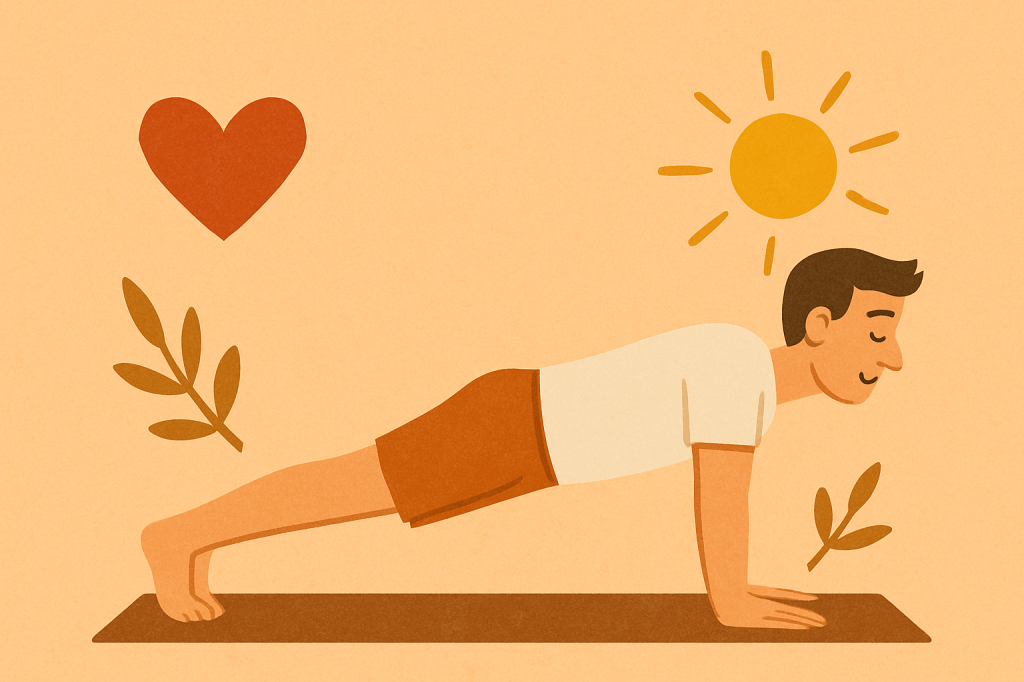
I’ve been doing the same set of exercises every morning for about two years now, and they’ve become absolutely indispensable. Not in some dramatic, life-changing way—more like how a good night’s sleep makes everything else a little easier. But after this much time, I can feel the difference when I skip even a day.
The Practice
Right after I wake up, before checking my phone or getting pulled into the day’s demands, I spend about 10 minutes moving through a simple sequence I designed for myself. Since I’m a guy who spends most of his day at a desk, this combination might be particularly useful for other men dealing with similar challenges—tight hips, weak core, rounded shoulders from too much screen time.
I do these back-to-back without rest in the middle—it creates a flow that keeps your body warm and engaged throughout the entire sequence.
The Core Flow:
- Forearm plank – 60 seconds
Rest on your forearms and toes, body in a straight line from head to heels. Engage your core to prevent sagging or hiking your hips. - High plank – 60 seconds
Push-up position with straight arms, hands directly under shoulders. Keep your body rigid like a board. - Side planks – 30 seconds each side
Lie on your side, prop yourself up on one forearm, stack your feet. Lift your hips to create a straight line from head to feet. This is my recent addition for targeting love handles—I’m still weak on these so starting with shorter holds. - Downward dog – 30 seconds
Start on hands and knees, tuck toes under, lift hips up and back. Create an inverted V-shape, pressing hands into floor. - Standing forward fold – 30 seconds
Stand with feet hip-width apart, hinge at hips and fold forward. Let your arms hang heavy or hold opposite elbows. - Cobra pose – 30 seconds
Lie face down, place palms under shoulders, press chest up while keeping hips on ground. Gentle backbend that also engages neck muscles—I’ve found this particularly helpful for strengthening the throat area, which can be beneficial for those dealing with sleep apnea. - Worship pose – 15 seconds
From hands and knees, sit back on your heels, extend arms forward on ground, rest forehead down. Also called child’s pose. - Cow pose – 60 seconds
On hands and knees, arch your back and lift chest and tailbone toward ceiling. Let your belly drop. - Cat pose – 60 seconds
From hands and knees, round your spine toward ceiling, tuck chin to chest. Opposite of cow pose. - Butterfly stretch – 30 seconds
Sit with soles of feet together, knees apart. Gently pull feet toward you and lean forward slightly. - Kneeling hip flexor stretch- 30 seconds each knee
Step one foot forward into a lunge, lower back knee to ground. Push hips forward to stretch the front of your back leg. - Tabletop bridges – 10 reps
Lie on back, knees bent, feet flat. Lift hips up by squeezing glutes, creating a straight line from knees to shoulders.
Sometimes I’ll do a shorter version before bed—maybe just the planks and a few stretches. The key isn’t perfection; it’s consistency.
Why These Poses Matter
Each movement serves a specific purpose for the modern desk worker. The planks build genuine core strength—not just abs, but the deep stabilizing muscles that support your spine during long sitting sessions. The hip flexor stretch directly counters the tight hips that come from chairs, while downward dog opens up the shoulders and posterior chain that get compressed from hunching over screens.
The cat-cow sequence mobilizes your entire spine, joint by joint, which is crucial when you spend hours in one position. Cobra pose strengthens your posterior chain while opening your chest—essentially the opposite of everything your body does at a computer. The butterfly stretch targets the groin and inner thighs, areas that tighten from sitting but rarely get attention in typical workouts.
What I’ve found is that these movements work synergistically. The strength holds create stability, the stretches restore mobility, and the combination seems to reset my posture for the entire day.
What I’ve Noticed
After about two years of consistent practice, my core feels fundamentally different. Not just stronger, but more… present. Like there’s a steady foundation supporting everything else I do. The combination of planks, stretches, and breathing work seems to wake up my entire system in a way that coffee never could.
The flowing between poses creates a nice rhythm—moving from strength holds into stretches, then back to activation. It feels like I’m checking in with my whole body before the day begins. At this point, skipping the routine feels like starting the day without brushing my teeth—technically possible, but something essential is missing.
The Real Value
Here’s what I think matters most: having something that anchors your day. Something that says, “Before I give my energy to everything else, I’m going to give a few minutes to myself.”
This particular sequence works for me because it hits the major muscle groups I need for sitting at a desk all day, opens up the areas that get tight, and activates my core in a way that carries through the rest of my activities. But your anchor might be completely different.
Making It Yours
I’m sharing this not because these exact exercises are magic, but because the principle seems universal: find something simple that activates your body and do it consistently.
Make it configurable so you can simplify when you don’t have time—reduced duration, skipped parts, whatever works. Include movements that give you joy and activate parts of your body that need attention. Pay attention to your body and it will be easy to sustain.
The specifics matter less than the regularity. I’ve tried elaborate workout routines before, but this is the first thing that’s actually stuck—probably because it’s short enough to do even on busy mornings and comprehensive enough to feel worthwhile.
Still Experimenting
This is very much a living practice. Some days I hold the planks longer, other days I barely make it through. I’ve added and removed exercises as I’ve learned what my body needs. The hip flexor stretch is recent—I added it after a small running injury taught me how tight those muscles had become.
I’m curious about what would happen if I kept this up for another few years. Or what other small movements might be worth adding. The beauty of keeping it simple is that there’s room to evolve without starting over.
The Invitation
If you’ve been thinking about adding some movement to your mornings, maybe start with just one thing. A single plank. A brief stretch. Something that says, “I’m taking care of this body I live in.”
Build from there, but only if it feels sustainable. The goal isn’t to sculpt an idea body or achieve some perfect routine. It’s to have a daily practice that supports everything else you want to do.
What matters is finding your own version of this—something that anchors you, activates your core (literally and figuratively), and feels sustainable enough to do tomorrow, and the day after that.
What’s your daily anchor? I’m always curious to hear what simple practices work for others.

Leave a comment