

Some debts outlive their debtors by centuries. During my time in Paris, I found myself carrying one—a gratitude so profound it demanded pilgrimage to a grave, an acknowledgment that someone’s art had once been my anchor during a time when everything felt unmoored.
The Music That Got Me Through
The past couple of years have been difficult in ways that are hard to explain. Not catastrophic, just persistently heavy. Those stretches where the future feels opaque and you’re not sure who you’re becoming. During those months, I found myself turning to Chopin’s music with an intensity that surprised me.
Three pieces became essential:
- Nocturne No. 1 in B-flat minor, Op. 9 No. 1
- Nocturne in E-flat major, Op. 9 No. 2
- Étude No. 3 in E major, Op. 10 No. 3 (“Tristesse”)
I’m no expert on Chopin or classical music—far from it. I don’t pretend to know the technical brilliance or historical context behind these pieces. But in those months, they lured me in, intuitively. I just couldn’t explain it. They felt like quiet companions to the fog I was walking through.
There’s something in his music that resists the tyranny of forced optimism. It doesn’t try to fix you. It lingers in uncertainty without flinching, finds beauty in sorrow without asking you to turn it into something else. In those months, that was exactly what I needed—music that didn’t demand clarity, only presence.
The Reality of Cemetery Logistics
Planning the visit proved trickier than expected. Père Lachaise Cemetery closes at 5:30 PM—earlier than I’d assumed. Finding appropriate flowers near the cemetery was hit or miss, and I ended up rushing through Parisian streets with roses, racing against closing time.
When I arrived, I had maybe an hour. Not the peaceful visit I’d imagined, but what I had to work with. Go early if you’re planning your own pilgrimage—the cemetery opens at 8 AM, and you’ll want time to navigate without feeling rushed.
Finding Him
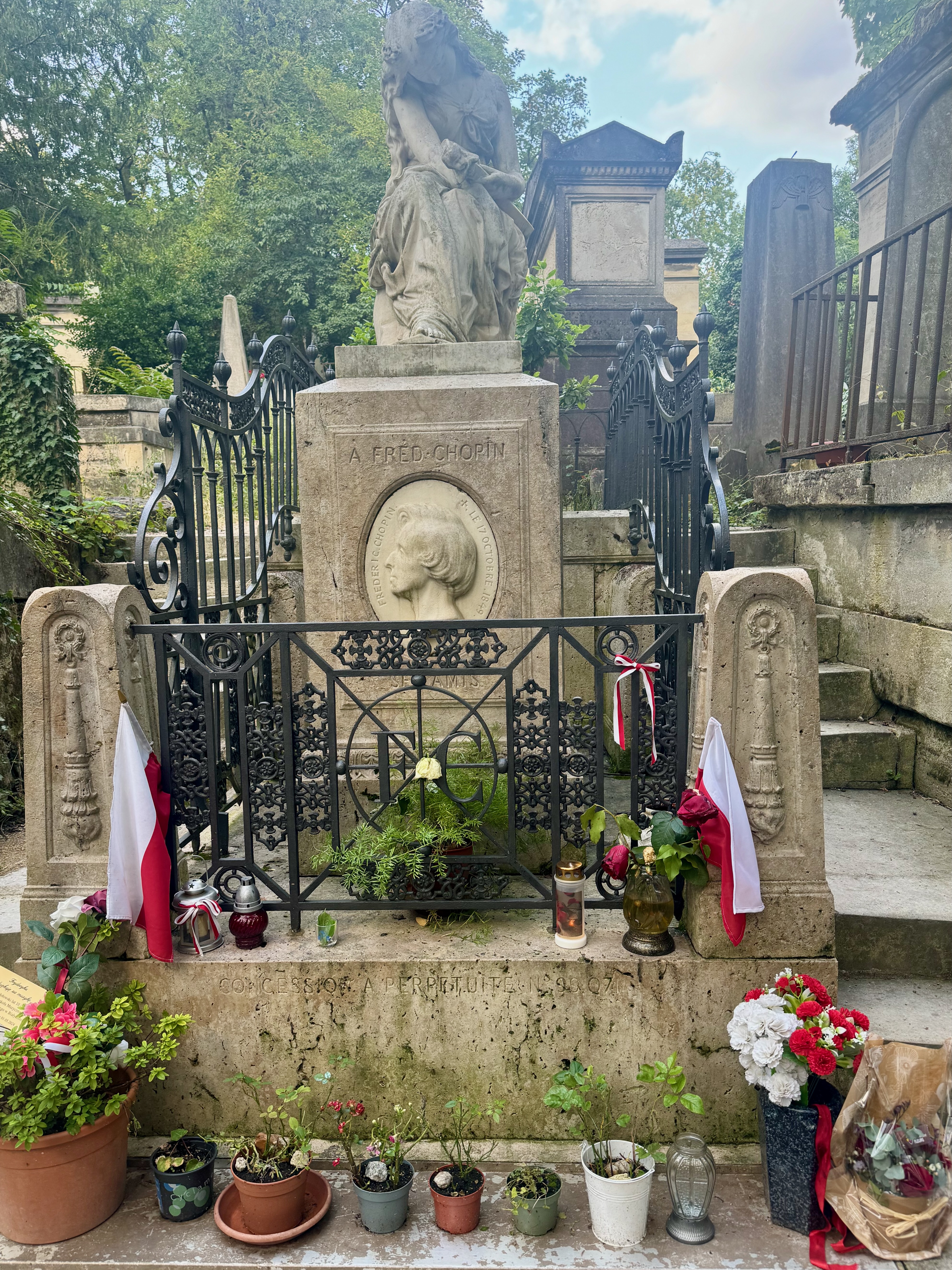
Chopin’s grave stopped me short despite my time pressure. The monument features Euterpe, the muse of music, watching over his resting place. Polish flags flanked either side—a reminder that though he lived his adult life in Paris, Poland never left his music. Fresh flowers scattered around the base joined my own roses, small offerings from visitors who felt compelled to leave something beautiful.
With closing time approaching, I tried to compress months of gratitude into a few minutes. How do you thank someone who isn’t there? How do you acknowledge what their work meant during your lowest points?
I thought about those nights when his music was the only thing that made sense. The way certain pieces could shift my emotional state—not by forcing optimism, but by giving permission to feel whatever I was feeling. Standing in the quiet cemetery, I realized this wasn’t about talking to him anyway. It was about acknowledging what his music had done for me.
The Living Legacy
Père Lachaise houses many cultural icons, but Chopin felt different—more personal. The others I admired from a distance; he had been there with me during the hardest stretches. There’s something profound about music’s ability to transcend time like that. Someone who died in 1849, yet his compositions still reach across nearly two centuries to give exactly what someone needs.
My rushed visit wasn’t what I’d planned, but maybe it was more honest. Life doesn’t give us perfect conditions for meaningful moments. Sometimes you express gratitude on the run, honor what matters within whatever constraints you’re working with.
The Thank You That Needed Saying
The flowers I left are likely gone by now. But the music continues, and so does my relationship with it. That’s the real ongoing conversation—not the one-time visit, but the daily choice to keep listening, to keep being grateful.
If you’ve ever had art really save you during dark times, you understand the debt that creates. Not one that can be repaid, but one that needs acknowledging. My visit was that acknowledgment—imperfect, rushed, but necessary.
Chopin’s music plays somewhere in the world every day. That’s monument enough. But I’m glad I made the trip to say thank you in person.
Père Lachaise Cemetery: 8 AM – 5:30 PM (summer). Visit early, bring flowers from elsewhere, and don’t expect perfect conditions for profound moments.

Leave a comment